Sunday, August 27, 2017

India and China, in war of words, are at a standoff

In the Himalayan highlands, a small stretch of rocky plateau is at the centre of a military standoff, with two Asian behemoths breathing fire at one another as Bhutan, an involved bystander, sinks into the shadows.
The location – Doklam – is barely 89 square kilometres of land in dispute between Bhutan and China, with India playing protective mother hen to Bhutan. The current escalation is new, but the heart of the matter is not: Two countries are jockeying for neighbourhood control, fed by strategic concerns and the memory of the 1962 war, one in which China dealt India a crushing military blow. Bhutan is merely the stage where the second act of live theatre is unfolding.
The contested area is strategically located, nestled between Tibet’s Chumbi Valley on the west and Sikkim, India, in the south. Through the pass into India one enters the Siliguri Corridor, otherwise known as Chicken’s Neck, a narrow stretch of land which provides the only land access between India’s Bengal state and its eight northeastern states where 45 million Indians live. Chicken’s Neck gives India reason to worry.
China, of course, is a planning pro. Road building – and major engineering projects – are a key part of its strategic goal to reach far-flung border areas. Several decades ago it achieved a herculean task by building a railroad through Xinjiang province. The rails spliced through the Taklamakan Desert, a silk route which had the reputation: “Go in and you will never come out.” China did, connecting the mainland to Urumqi and flooding the city with oilmen hungry to extract the province’s abundant natural resources. Much, of course, to the chagrin of Xinjiang’s autonomy-seeking populace.
The Doklam conflict was initiated by a similar – if less ambitious – road project, which could give China near-access to the pass that enters India’s Sikkim region, east of which China also has land claims. India was able to respond quickly because of its long-established foothold in Bhutan. With troops in place and a military academy located in nearby Haa Valley, its foot soldiers rose to the occasion.
The backdrop to this current conflict is both political and emotional. India, while concerned over China’s strategic moves, is also hankering for revenge. In the one-month 1962 war, almost 1,400 Indian soldiers were killed over China’s 700. Prior to facing off then, the two had been on good terms: a common slogan of the time was “Hindi-Chini bhai-bhai” (India China Brothers Forever).
Yet those were early days for a young India, which had secured independence from the British in 1947, inheriting unclear boundaries and dated agreements like the 1890 agreement China is forcing upon Bhutan today.
In China, the Communist Party came to power in 1949, leading its forces into Tibet in 1959. When the Dalai Lama sought refuge in India, Mao Zedong could not have been pleased. He was also concerned (wrongly) about India’s interest in Tibet. While asserting its military superiority in 1962, however, it lost the “Indo-China Brothers Forever” momentum. From this point on, its camaraderie with Pakistan also irked India.
The perception of betrayal partially fuels reactions in India today, with official statements reminding China that India is no longer a country with little means. Its decision to push troops into position did not appear to involve Bhutan.
This puts Bhutan in an uncomfortable place, with a limited role in current negotiations. Prior to this conflict, Bhutan had 24 border discussions with China. Now the discussions are between India and China, not Bhutan and China.
On its southern border, Bhutan has a 1949 “friendship” treaty with India, in which it ceded significant control over its defence and foreign affairs. India trains its military, builds roads and projects like the hydroelectric plant.
Many Bhutanese speak Hindi with ease, partly as a result of their love for Indian TV shows. But such ties come at a cost. Bhutan’s economy is tourism dependent; it levies hefty foreigner tourism fees on luxury travellers but Indian visitors enjoy visa-free entry. As times change, though, some Bhutanese want to be less clearly aligned – they seek a more balanced relationship with India and China.
But two months into the standoff, with Indian and Chinese soldiers pelting each other with stones at the border and Chinese officials declaring that bonhomie is out of the question unless Indian soldiers withdraw, a change in the status quo appears unlikely. The mountain kingdom preaching happiness remains stuck between a rock and a hard place.

Saturday, December 19, 2015

Introduction


Personal websites are becoming increasingly popular. They can be used effectively for promotion, job searches, personal branding, and just for communicating with friends and family. These personal websites can often serve as a creative outlet and allow the site owner more freedom than they would have with a website that is tied to their business. Personal websites also allow the owner to change directions easily if their interests or purpose for the site changes at some point in the future.

Hi, I am Hari Regmi and I like making nice things on the web.I design and build websites. I live in a cool city kathmandu, Nepal and an employee at Central Bank. I have tried my best to update this website with useful tips and articles peripheried in economic/financial agendas that I have written and feared of going unrecorded. Hopefully, This site will pay some fruitful knowledge for your click. Feel free to join hands in my efforts to inbox/comment and provide feedbacks.

Wednesday, December 16, 2015

Toni Hagen's Documentary who charted out Nepal's development pathways.

Toni Hagen (August 17, 1917 in Luzern – April 18, 2003 in Lenzerheide) was a Swiss geologist and a pioneer of Swiss development assistance. Dr. Hagen was the first foreigner to trek throughout Nepal during geological and geographic survey work and mapping on behalf of the United Nations. He clocked over 14,000 km walking several times across Nepal, where the topography is mostly hilly to snow-covered. He filmed Nepalese cultural and ethnic diversity originally as produced as a silent documentary, and later with an English narration in his own voice. Dr. Hagen is also the author of several books including a book entitled Nepal. After taking a diploma in engineering and geology from the Swiss Federal Institute of Technology in Zurich, he took a doctorate in the geology of the Welsh mountains and then became a research assistant at the Zurich Geological Institute. Hagen first visited Nepal in 1950 with a first Swiss development assistance mission. In 1952 he was employed by the government of Nepal and also worked for the United Nations. He explored the geography of that Himalayan state.
From 1966 to 1971, as adviser to the UN's Development Program, he was given a special mission in crisis-hit areas worldwide including Africa, the Middle East and Asia.Hagen was a pioneer in the field of development aid, undertaking missions to the Himalayas, eastern Africa and South America in a career spanning over 60 years. After Tibet was taken over by China in 1959, Hagen used his influence to help the Tibetan refugees. During the next years he gained Dalai Lama's confidence. He managed to bring approximately 1,000–1,500 Tibetans to Switzerland. Hagen retired from the UN in 1972, worked as a freelance adviser for organisations involved in foreign aid and later returned to the Federal Institute of Technology at Zurich where he lectured on the problems of the developing world. In the early 1980s he established the Toni Hagen Foundation in Switzerland and Nepal to promote democratic reforms and better understanding between different ethnic groups in Nepal. In 1999 Dr. Toni Hagen filmed a story of his life, The Ring of the Buddha (German title: Der Ring des Buddha), which also included some original materials from the 1960s. Soon after the film was shown, he died in early 2003 at the age of 85 in his home in Lucerne on Good Friday, three days after his wife, Gertrud in Lenzerheide. Here's a  documentary about Nepal by him.


VISION OF FUTURE

- Hari Prasad Regmi

By 2050, if Nepal is still poor, it will struggle to survive between two of the most prosperous and powerful nations on earth. By 2050, Nepal's northern neighbor China is projected to be the most prosperous nation in the world and India to the south is expected to become the third most prosperous. Hence, Nepal in between faces an existential crisis and at the same time an immense opportunity. Throughout its history, Nepal has pragmatically dealt with both India and China to preserve its sovereignty. All successful nations tie their foreign policy with their own prosperity, by focusing on interdependence, multi-alliances and by responding, as opposed to reacting. On the contrary, since the last 20th century Nepal's foreign policy has been a contradiction, swinging wildly between dependency and reactionary.

Nepal's various rulers in this past century invited multiple direct or indirect foreign interferences, which worked against Nepal's prosperity. The 'economic blockade' in 2015 has served as a stark reminder of the painful consequences of decades of neglect of foreign relations and internal security. Today, Nepal remains a painfully dependent, unstable and desperately poor nation in a super-powerful neighborhood. We acknowledge the painful situation where our two giant neighbors pose a clear and present threat to our sovereignty if Nepal does not transform into a prosperous nation, along with them, in the near future. Therefore Nepal's foreign and its adjoining socio-economic policies have to be persistently guided by the reality that to survive, Nepal must become a prosperous nation by 2050.


To achieve this, Nepal should engage in a continuously evolving "interdependent" prosperity building, delicately balanced relationship with its two big neighbors and the world beyond. We propose a holistic policy called the North-South doctrine for Nepal. This doctrine envisions: i) building a perception of Nepal as at "the center of the world," ii) interdependent economic relationship between Nepal, India and China, iii) building the country as a bridge between its two neighbors, iv) protecting neighborhood to strengthen internal security and v) holistic cross-border cultural understanding. Nepal should start building a perception that it is at the center of the world because of its geo-strategic location between China and India. Why? By 2050 the global center of gravity will shift to this region, and Nepal happens to be right in the middle of all this. Through subtle diplomacy we will influence Chinese and Indians to think of our region as the center of the world. To build this perception internationally, Nepal will use "Center of the World" tag on its diplomatic channels and encourage travelers and migrants, expatriate Nepali community and students studying overseas to repeatedly brand this analogy. Inside Nepal, we persistently inject this terminology into our citizen's psyche through our leadership, education system, literature and media so that we truly believe and take advantage of our location as the "center of the world". North-South doctrine advocates Nepal as a bridge between India and China. It ensures smooth safe zone, a cushion, a transition from one super-power to another super-power that compete fiercely yet need to collaborate closely to stay as superpowers. Nepal will become a transit, a hub for both Indian and Chinese businesses. To ensure this, Nepal will set up frameworks to ensure it acts as a smooth transition for its two neighbors to do 'fair trade' with each other. Nepal will focus on highly sought after agricultural and economic needs of India and China such as herbs, crops, minerals and other strategic resources that grow or are found specifically only in geography like Nepal's. Then India and China will depend on Nepal, too.


To build an interdependent economy, mega-infrastructure financial institutions like North-South Bank will be set up with equal stake of Nepal, India and China. This bank will invest on billion + dollar projects focusing on "water" and clean energy along with "mega-transit-transport infrastructure' projects that builds China and India's prosperity through Nepal. Initially perhaps it will also focus on fast-track highways/electric rail lines (linking Nepal's China border with its Indian border in at least five strategic places such as Far-western, Mid-western, Western, Central, Eastern development regions). North South doctrine dictates that Nepal becomes an effective buffer state between China and India. Nepal has to focus on becoming a facilitator, dialogue builder between India and China to improve relations that brings these two countries closer. On matters of any international dispute between India and China, Nepal uses its foreign relations center, the 'North-South Center' to continuously foster dialogue between two great neighbors. According to this doctrine, Nepal has to be aligned with both India and China, always on a watch for anything that hampers equitable prosperity in India and China as well.

Nepal will establish disaster security zones in the Western, Central and Eastern regions where at least a year long supply of strategic security materials like food, oil, equipment, transport and medicine are stored in seismic-resistant facilities to immediately respond to disasters in Southern Tibet, Nepal, North-East and North-West states of India. Nepal will be generous and empathetic in its use of strategic resources like water for the security of its neighbors too. Nepal will maintain an open but monitored border (monitor movement of vehicles and people through smart identification systems/ technology) ensuring hassle-free trade and movement for both India and China. Nepal will share vital neighborhood security information with its neighbors to help convince India and China. It will practice the policy of "peacekeeping through peacekeepers". It ensures its security forces transition to UN peacekeeping forces committing majority of its total force for international peacekeeping duties by 2030.


The North-South doctrine will promote Nepal as a 'zone of spirituality' by adopting a policy of "empathy through unity" to influence its immediate neighbors. Nepal can enhance spiritual tourism as a strategy to make Indians and Chinese empathize with the Nepali way of life by perfecting our "guests as gods" attitude. Nepal will build itself as a spiritual resource center for over a billion Hindus and nearly a half a billion Buddhists. To enhance deeper bonding between its intellectuals, a North-South University in Nepal along with Satellite centers in China and India will focus teaching interdisciplinary studies, building creativity around the working together of three distinct cultures and its myriads sub-cultures and languages. 
Meaningful implementation of any national policy is dependent on ethical delivery by its leaders. The North-South doctrine will evolve according to the challenges of the future but will remain focused on building a prosperous Nepal and a prosperous neighborhood. We envision all foreign relations and socio-economic policies of Nepal and its political parties in the next few decades to go through a "one door" policy which all political forces, bureaucracy and planners shall follow. The "North-South" doctrine is a start  the writer recommends for Nepal.

Sunday, December 13, 2015

Self-Reliant Economy : Myth Vs Reality

कविताः शान्तिप्रेमी

शान्ति  प्रेमी नेपालीको
आज किन यस्तो हाल भो ?
बुद्ध जन्मेको नेपालमा
बुद्धिको किन अनिकाल भो ?
पहरा गर्ने स्वयम्भुको तिनै नेत्र
कहीं बन्दै त भएनन ?
रक्षा गर्ने पशुपतिले शक्ति बोकी
कहि अन्तै त गएनन ?

बुद्धको शान्त अनुहारमा पनि
चिन्ताको रेखा भेट्छु म ।
स्वयम्भुको मौन आँखामा पनि
विवशताको आँशु देख्छु म ।
विशाल हिमालको छातीमा
आजभोलि बिजुली चम्किन्छरे ।
संधै शान्त हुने ती गाउँ बेसिमा
पनि चट्टान थर्किन्छरे ।

                            मन उदाँश छ,सोच्दै छु
                            कहीं शाहीदको बलिदान
                            त्यसै खेर जाने त हैन ?
                                                  लुटेरा हरु तयार छन बस्ती लुट्न
                            कहीं पुर्खाको धरोहर लुटेर लाने त हैन ? 


Dashain Festival in Nepal


During the month of Kartik (late September and early October), the Nepalese people indulge in the biggest festival of the year, Dashain. Dashain is the longest and the most auspicious festival in the Nepalese annual calendar, celebrated by Nepalese of all caste and creed throughout the country. The fifteen days of celebration occurs during the bright lunar fortnight ending on the day of the full moon. Thorough out the kingdom of Nepal the goddess Durga in all her manifestations are worshiped with innumerable pujas, abundant offerings and thousands of animal sacrifices for the ritual holy bathing, thus drenching the goddess for days in blood.

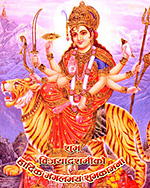
Dashain commemorates a great victory of the gods over the wicked demons. One of the victory stories told is the Ramayan, where the lord Ram after a big struggle slaughtered Ravana, the fiendish king of demons. It is said that lord Ram was successful in the battle only when goddess Durga was evoked. The main celebration glorifies the triumph of good over evil and is symbolized by goddess Durga slaying the terrible demon Mahisasur, who terrorised the earth in the guise of a brutal water buffalo. The first nine days signify the nine days of ferrous battle between goddess Durga and the demon Mahisasur. The tenth day is the day when Mahisasur was slain and the last five days symbolise the celebration of the victory with the blessing of the goddess. Dashain is celebrated with great rejoice, and goddess Durga is worshiped throughout the kingdom as the divine mother goddess.

In preparation for Dashain every home is cleansed and beautifully decorated, painted as an invitation to the mother goddess, so that she may visit and bless the house with good fortune. During this time the reunion of distant and nearby relatives occur in every household. The market is filled with shoppers seeking new clothing, gifts, luxuries and enormous supplies of temple offering for the gods, as well as foodstuffs for the family feasting. Thousands of sheep, goats, ducks, chicken and water buffalo are prepared for the great slaughter. All types of organisations are closed for ten to fifteen days. Labourers are almost impossible to find; from the poor to the rich, all enjoy the festive mood. Anywhere you go the aroma of 'Vijaya Dashami' is found.
The first nine days of Dashain are called Nawa Ratri when tantric rites are conducted. In Nepal the life force is embodied in the divine energy and power of the female, depicted as goddess Durga in her many forms. All goddess who emanated from goddess Durga are known as devis, each with different aspects and powers. In most mother goddess temples the deity is represented simply as a sacred Kalash, carved water jug or multiple handed goddess holding murderous weapons. During these nine days people pay their homage to the goddess. If she is properly worshiped and pleased good fortunes are on the way and if angered through neglect then misfortunes are around the corner. Mother goddess is the source of life and everything.
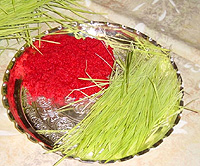
The first day of Dashain is called Ghatasthapana, which literally means pot establishing. On this day the kalash, (holy water vessel) symbolising goddess Durga often with her image embossed on the side is placed in the prayer room. The kalash is filled with holy water and covered with cowdung on to which seeds are sown. A small rectangular sand block is made and the kalash is put in the centre. The surrounding bed of sand is also seeded with grains. The ghatasthapana ritual is performed at a certain auspicious moment determined by the astrologers. At that particular moment the priest intones a welcome, requesting goddess Durga to bless the vessel with her presence.
The room where the kalash is established is called 'Dashain Ghar'. Generally women are not allowed to enter the room where Dashain puja is being carried out. A priest or a household man worships the kalash everyday once in the morning and then in the evening. The kalash and the sand are sprinkled with holy water everyday and it is shielded from direct sunlight. By the tenth day, the seed will have grown to five or six inches long yellow grass. The sacred yellow grass is called 'Jamara'. It is bestowed by the elders atop the heads of those younger to them during the last five days when tika is put on. The jamara is taken as a token of Goddess Durga as well as the elders blessing.
As days passes by regular rituals are observed till the seventh day. The seventh day is called 'Fulpati'.
In fulpati, the royal kalash filled with holy water, banana stalks, jamara and sugar cane tied with red cloth is carried by Brahmans on a decorated palanquin under a gold tipped and embroidered umbrella. The government officials also join the fulpati parade. With this the Dashain feasting starts.
The eighth day is called the Maha Asthami: The fervour of worship and sacrifice to Durga and Kali increases. On this day many orthodox Hindus will be fasting. Sacrifices are held in almost every house through out the day. The night of the eighth day is called 'Kal Ratri', the dark night. Hundreds of goats, sheep and buffaloes are sacrificed at the mother goddess temples. The sacrifice continues till dawn. While the puja is being carried out great feasts are held in the homes of common people where large amount of meat are consumed.
The ninth day is called Nawami: Temples of mother goddess are filled with people from dawn till dusk. Animals mostly black buffaloes are slaughtered to honour Durga the goddess of victory and might and to seek her blessing. Military bands play war tunes, guns boom and officers with beautifully decorated medals in full uniform stand there. When the function ends the courtyard is filled ankle deep with blood. On this very day the god Vishwa Karma, the God of creativity is also worshiped. All factories, vehicles, any machinery instruments and anything from which we make a living are worshiped. We also give sacrifices to all moving machinery like cars, aeroplanes, trucks etc. to get the blessing from goddess Durga for protection for vehicles and their occupants against accidents during the year. The entire day is colourful.
The tenth day is the Dashami: On this day we take tika and jamara from our elders and receive their blessing. We visit our elders in their home and get tika from them while our younger ones come to our home to receive blessing from us. The importance of Dasain also lies in the fact that on this day family members from far off and distant relatives come for a visit as well as to receive tika from the head of the family. This function continues for four days. After four days of rushing around and meeting your relatives Dashain ends on the full moon day, the fifteenth day. In the last day people stay at home and rest. The full moon day is also called 'Kojagrata' meaning 'who is awake'. The Hindu goddess of wealth Laxmi is worshipped. On this day the goddess Laxmi is given an invitation to visit each and everyone.

After Dashain everyone settles back to normal. After receiving the blessing of goddess Durga, people are ready to work and acquire virtue, power and wealth. Dashain thus is not only the longest festival but also the most anticipated one among all the festivals of Nepal.